AQA · GCSE · English Language
Scope of study
GCSE English Language is a skills-based qualification assessing critical reading and effective writing. This topic covers the core skills of identifying explicit/implicit information, analysing language and structure, evaluating texts critically, comparing writers' viewpoints, and demonstrating technical accuracy in creative and transactional writing.
- 5 min read
- 3 worked examples
- 5 practice questions
- 8 key terms
Study Notes
Overview
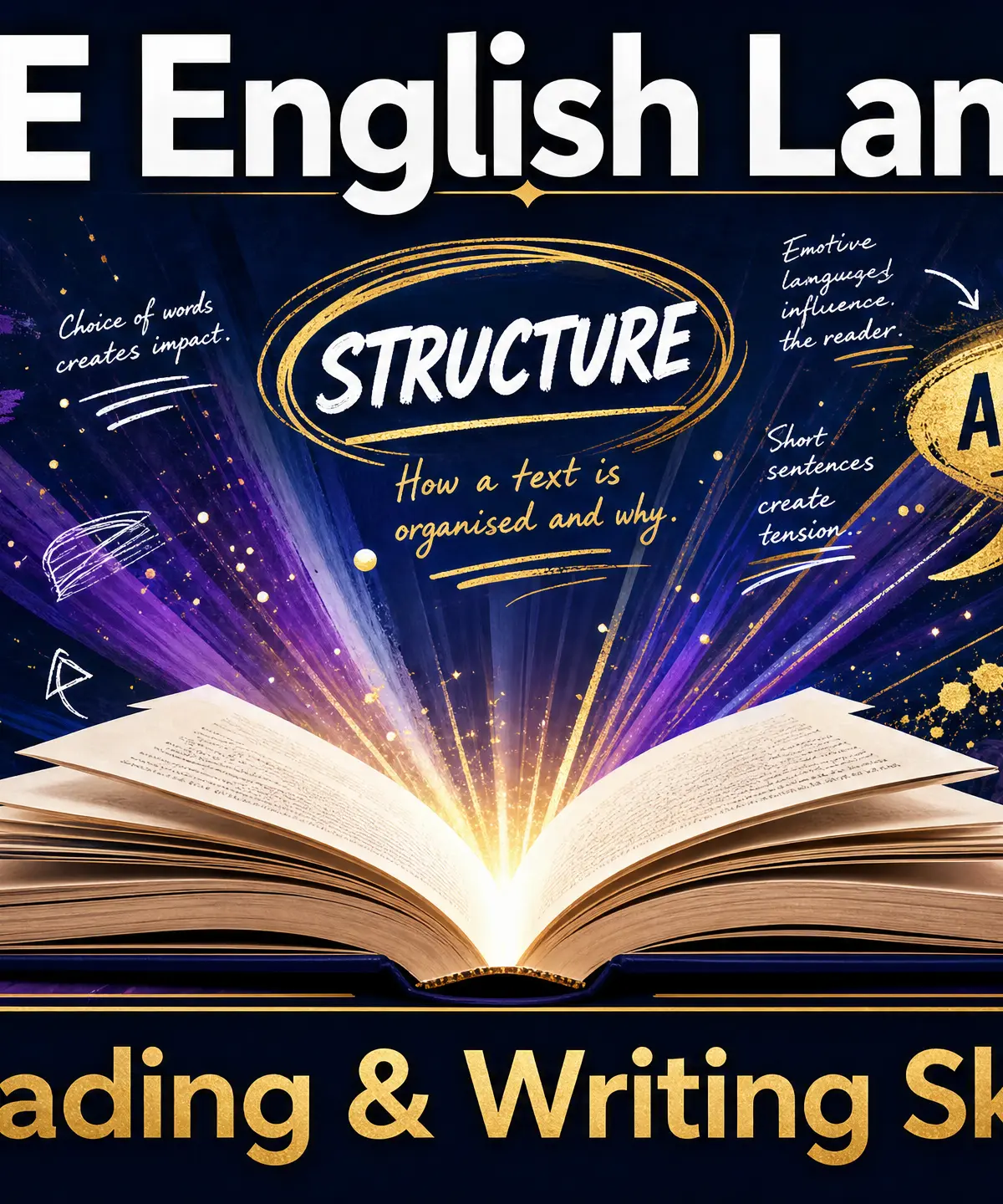
GCSE English Language assesses your ability to read critically and write effectively. Unlike English Literature, there are no set texts to memorise. Instead, you will face unseen fiction and non-fiction texts. Your success depends entirely on mastering core reading and writing skills, which we will break down in this guide.
Listen to our comprehensive 10-minute revision podcast to reinforce these skills:
Reading Skills
Identifying Information & Ideas
The most fundamental reading skill is locating and interpreting information.
- Explicit Information: This is stated directly in the text. For example, 'The door was locked.'
- Implicit Information: This is suggested or implied, requiring you to read between the lines. If a character 'tugs frantically at the handle, their breathing shallow and rapid', the writer implies panic without stating it explicitly.
When asked to 'identify' or 'list', examiners want explicit facts. When asked to 'infer' or 'interpret', you must explain the implicit meaning.
Analysing Language
Examiners award the highest marks for candidates who explain the effect of language, rather than just spotting features.
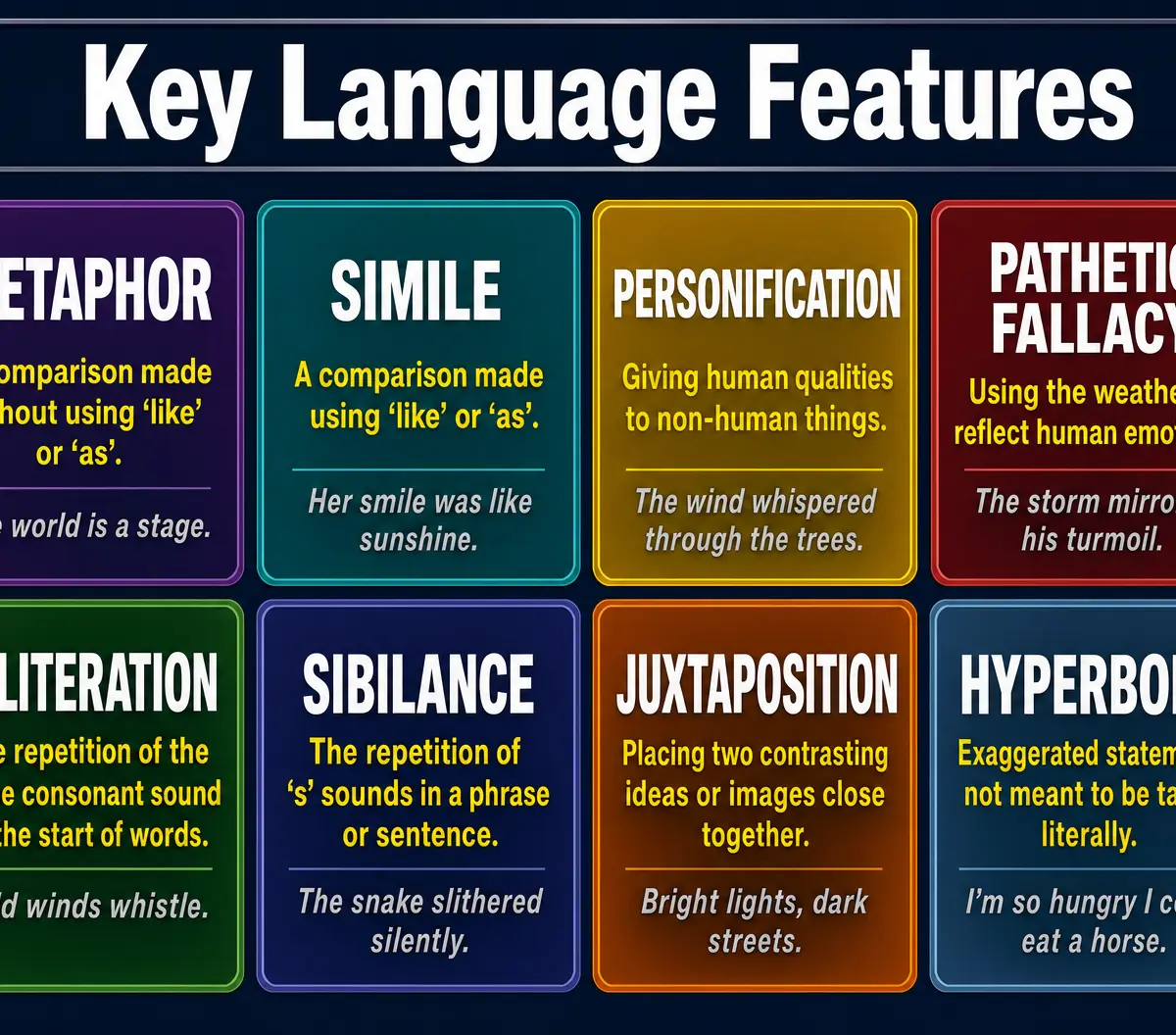
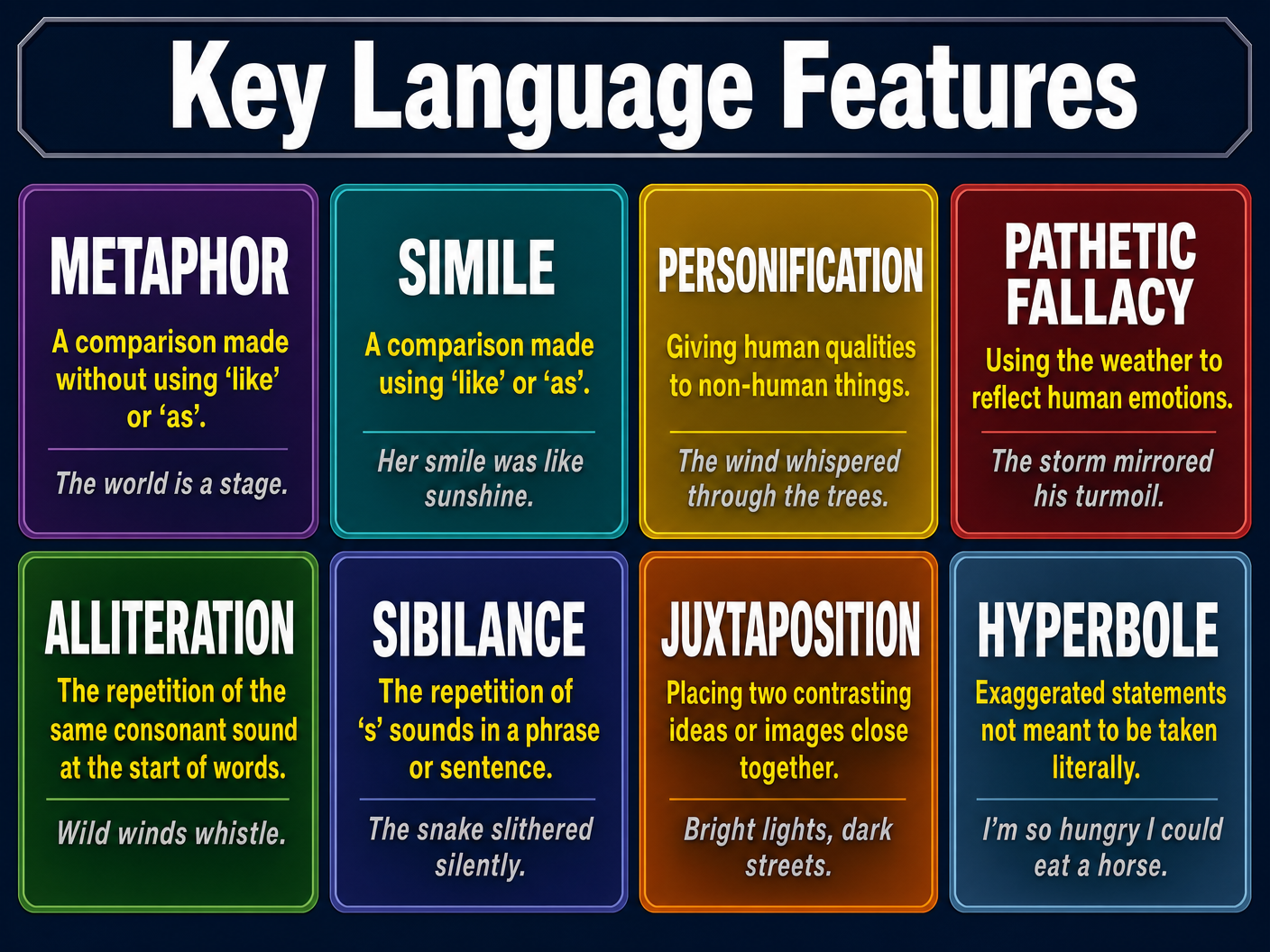
Key Language Features to Identify
| Feature | Definition | Effect on Reader | Example |
|---|---|---|---|
| Metaphor | A direct comparison stating one thing is another. | Creates vivid imagery; emphasizes specific qualities of the subject. | The classroom was a zoo. |
| Simile | A comparison using 'like' or 'as'. | Helps the reader visualize the subject by linking it to something familiar. | He ran like the wind. |
| Personification | Giving human qualities to non-human things. | Makes descriptions more relatable and dynamic. | The shadows danced on the wall. |
| Pathetic Fallacy | Using weather or environment to reflect human emotions. | Sets the mood and foreshadows events. | The violent storm mirrored his rage. |
| Alliteration | Repetition of consonant sounds at the start of words. | Creates rhythm, draws attention, or mimics a sound. | The cruel, cold wind... |
| Sibilance | Repetition of 's' sounds. | Can create a sinister, hissing tone or a soft, soothing mood. | The snake slithered silently. |
| Juxtaposition | Placing contrasting ideas close together. | Highlights differences and creates tension. | A bright flower blooming in the ashes. |
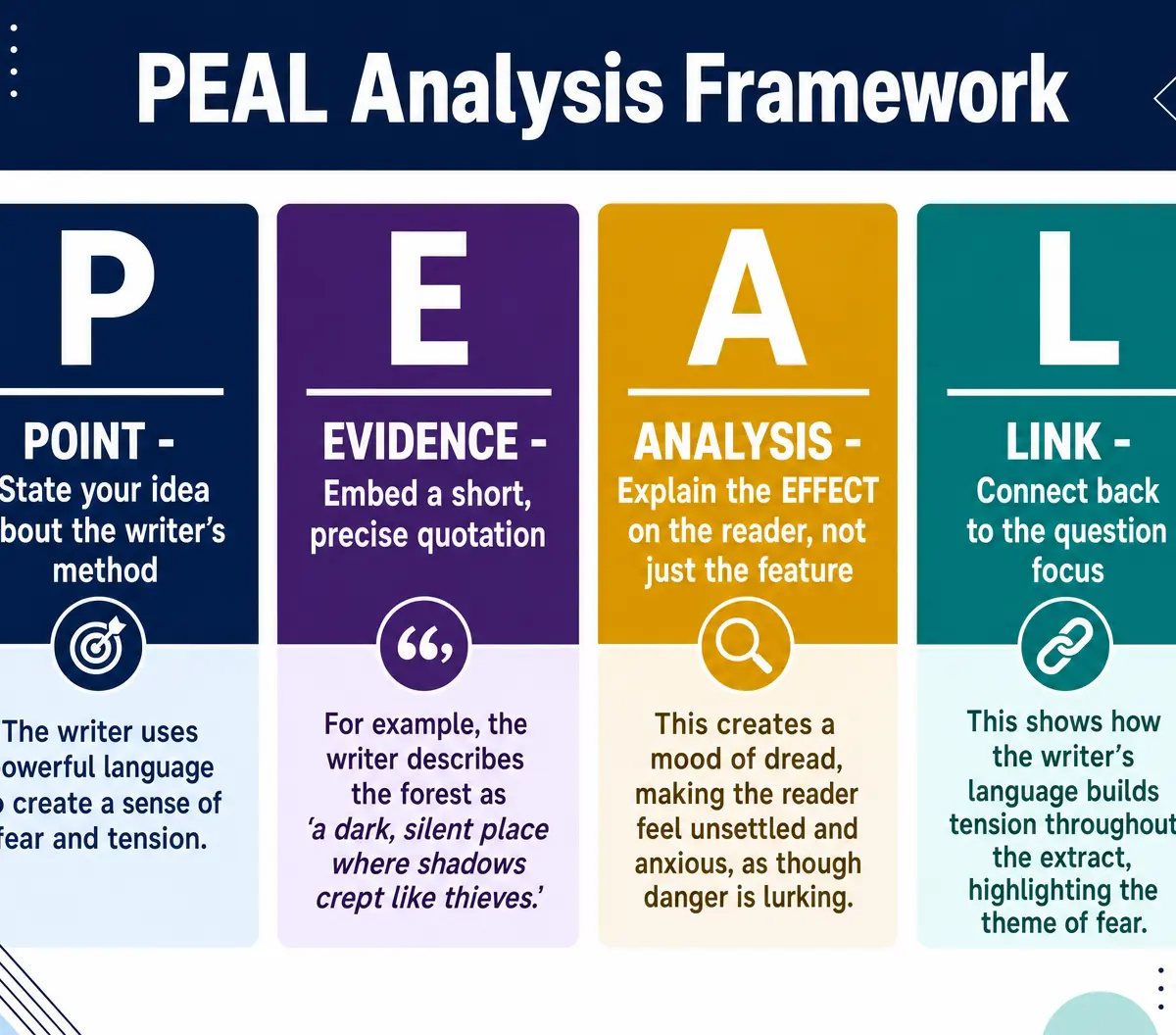
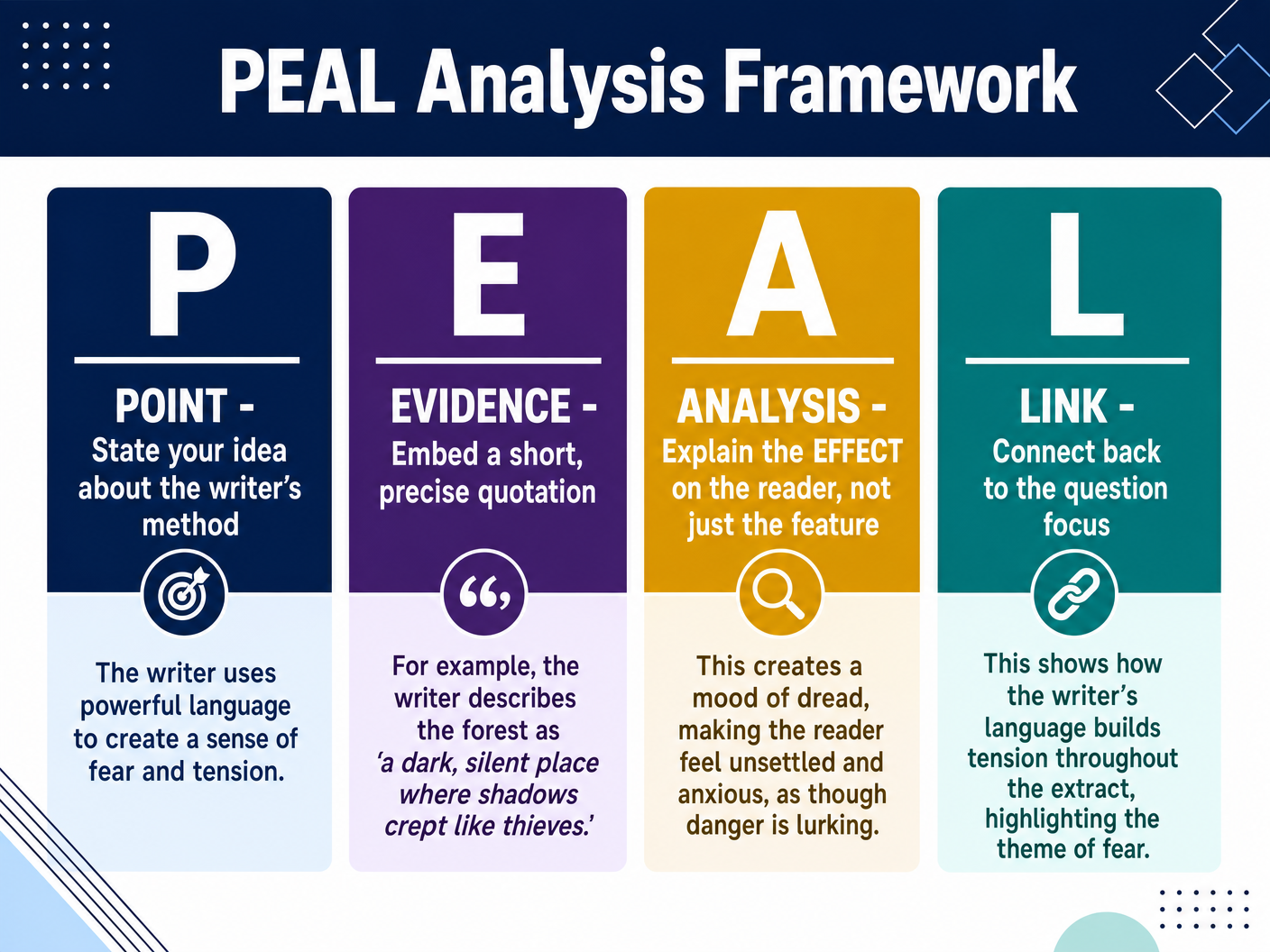
When analysing language, use the PEAL framework:
Analysing Structure
Structure refers to how a text is organised and built. Examiners want you to focus on the journey the writer takes the reader on.
Key structural features include:
- Openings: How does the text begin? Does it hook the reader immediately (in media res) or set the scene slowly?
- Shifts in Focus: Does the writer move from the setting to a character? From the past to the present? From an external view to an internal thought?
- Narrative Perspective: Is it first-person (I) or third-person (he/she)? Does it change?
- Sentence Variation: Are short sentences used for tension and impact, while long sentences are used for description or reflection?
- Endings: Is the ending cyclical (returning to the opening image) or a cliffhanger?
Evaluating Critically
Evaluation questions require you to form a viewpoint and support it with evidence. You must judge how well the writer achieves a specific effect.
Structure your evaluation: Statement → Evidence → Analysis → Link. Use evaluative phrases like, 'The writer is particularly effective when...' or 'This is highly convincing because...'
Comparing Writers' Viewpoints
When comparing two texts, identify what each writer thinks or feels, then compare the methods they use to convey those viewpoints. Always use a point-by-point structure (comparing Text A and Text B in the same paragraph) rather than writing about Text A entirely, then Text B.
Writing Skills
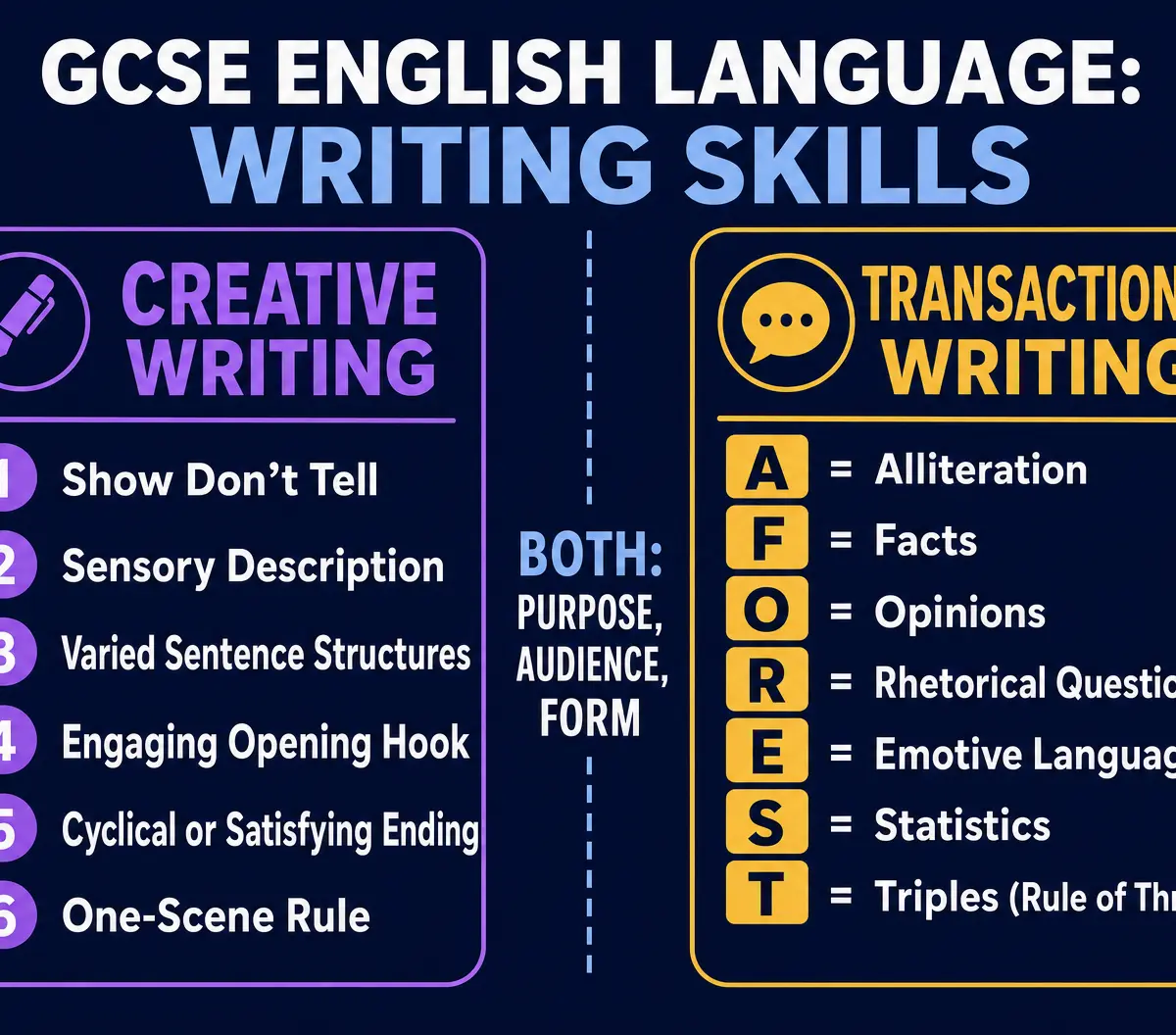
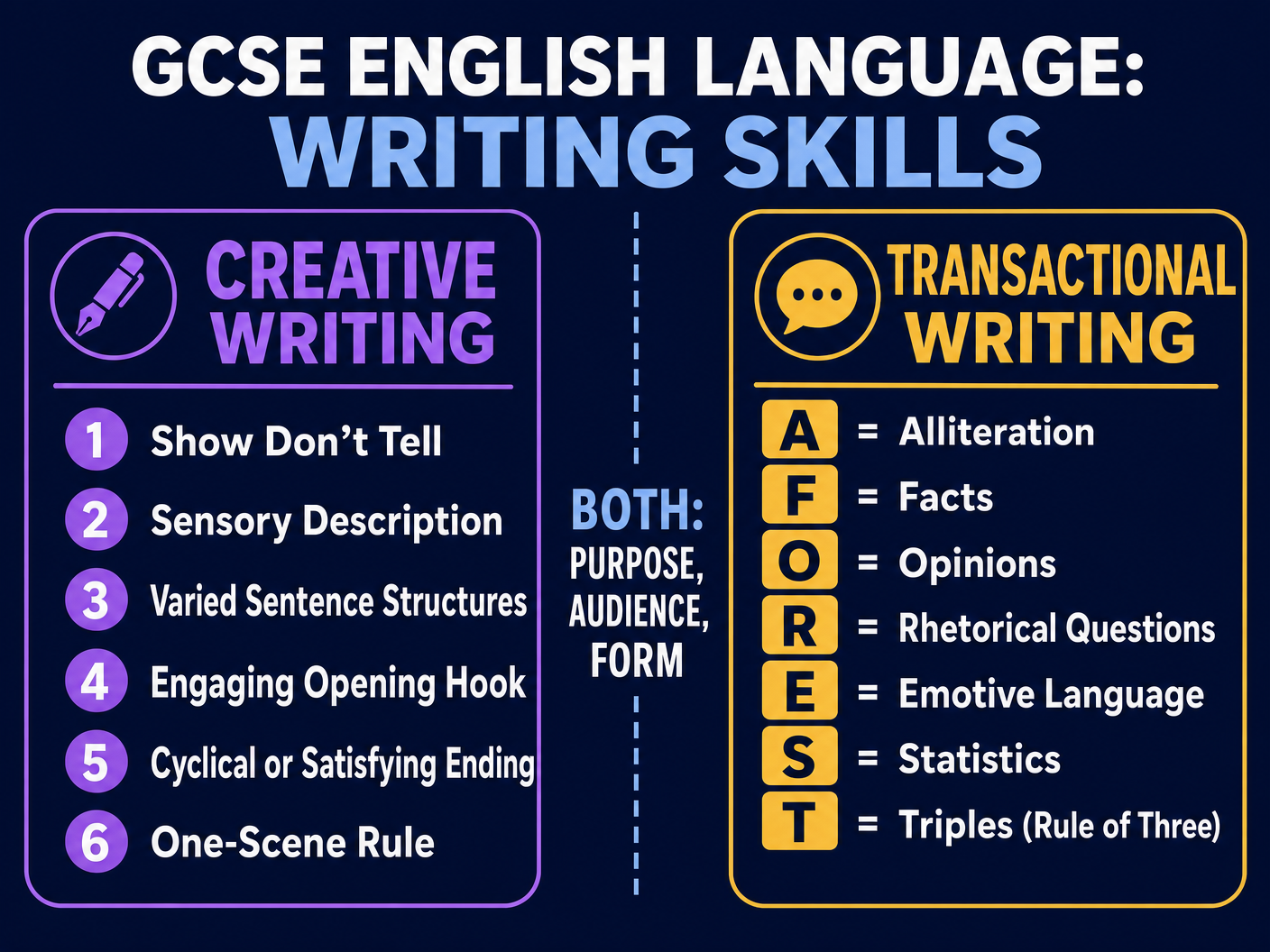
Creative Writing
Creative writing tasks (often a description or a narrative) test your ability to engage the reader.
- Show, Don't Tell: Instead of saying 'He was angry', describe his clenched fists and flushed face.
- Sensory Description: Use sight, sound, smell, touch, and taste to create a vivid setting.
- The One-Scene Rule: For a 45-minute exam, don't try to write an epic novel. Focus on one scene, one short timeframe, and describe it in detail.
Transactional/Non-Fiction Writing
Transactional writing (letters, articles, speeches) requires a clear understanding of PAF: Purpose, Audience, and Form.
Use the AFOREST techniques to persuade and argue effectively, but ensure your tone matches the required form (e.g., a formal letter vs. a lively magazine article).
Technical Accuracy (SPaG)
Spelling, Punctuation, and Grammar (SPaG) account for a significant portion of your writing marks.
- Ambitious Punctuation: Use semicolons (;) to link closely related independent clauses. Use colons (:) to introduce a list or an explanation. Use dashes (—) for dramatic pauses.
- Paragraph Cohesion: Use discourse markers (e.g., Furthermore, Conversely, Ultimately) to link your paragraphs smoothly.
Visual Resources
3 diagrams and illustrations
Interactive Diagrams
2 interactive diagrams to visualise key concepts
Conceptual Flow Outline
Overall English Language Exam Approach
Conceptual Flow Outline
Point-by-Point Comparison Framework
Worked Examples
3 worked examples — open one to explore the question and available guidance.
Practice Questions
Test your understanding — click to reveal model answers
Read the provided paragraph. List four things you learn about the house. (4 marks)
Hint: Look for explicit information. Keep your answers to short sentences or phrases.
Analyse how the writer uses language to describe the heat of the desert. (8 marks)
Hint: Select 2-3 strong quotations. Name the technique, embed the quote, and explain the specific effect on the reader.
How does the writer use structure to build tension in the extract? (8 marks)
Hint: Look for shifts in focus, changes in sentence length, or how the passage opens and closes.
Write a description suggested by this picture: [A busy, rainy city street at night]. (40 marks)
Hint: Use 'Show, Don't Tell'. Employ sensory description and vary your sentence structures. Plan before you write.
'The writer effectively makes us feel sympathy for the main character.' To what extent do you agree? (20 marks)
Hint: Form a clear viewpoint. Select evidence. Evaluate *how well* the writer creates sympathy.